
Storytelling Technique: How to Create Stories That Captivate an Audience
Storytelling Techniques: How to Make a Story Stay with Your Audience
A compelling story does more than describe what happened. It draws an audience into a world, gives them someone to care about and leaves them with something to think about. Whether you are writing a play, performing on stage or telling a story aloud, a few carefully chosen techniques can make the difference between a story that is heard and one that is remembered.
Begin with a clear point of view
Every story is shaped by the perspective through which it is told. A first-person narrator can create intimacy, while a third-person perspective may offer a broader view of events. In performance, point of view is also conveyed through movement, tone and focus: whose experience are we being asked to follow, and what do they notice?
Choosing a point of view helps establish the relationship between the audience and the story. It can also create dramatic possibilities. A character may misunderstand what is happening, conceal information or tell events in a way that invites the audience to question their reliability.
Give the story a clear desire
Audiences are naturally drawn to characters who want something. The desire need not be grand: a person might want to make an apology, keep a secret or get home before dark. What matters is that the audience understands what is at stake.
Once a character’s goal is clear, introduce obstacles. These could come from another character, the surrounding circumstances or the character’s own doubts. Conflict creates movement, and movement gives the story a reason to continue.
Use structure to build momentum
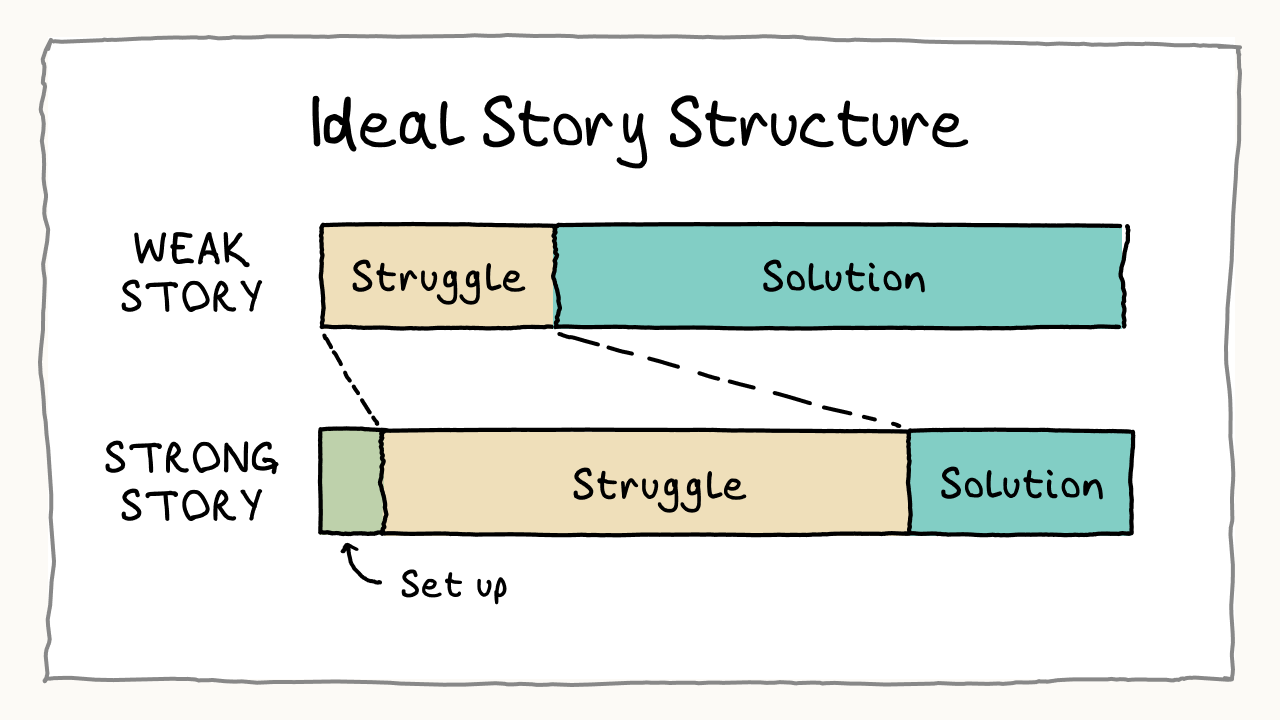
A useful story structure gives events a sense of progression. The audience is introduced to a situation, something changes, and the characters respond. Each decision leads to another consequence, gradually increasing tension until the story reaches a turning point or climax.
This does not mean every story has to follow the same formula. A story can move backwards in time, jump between different perspectives or leave some questions unanswered. Even an unconventional structure benefits from a sense of direction: the audience should feel that each moment is adding meaning or changing what comes next.
Show, don’t just explain
Instead of telling the audience that a character is frightened, look for ways to make that fear visible. A pause before speaking, a hand that will not stay still or an attempt to change the subject can reveal more than a direct explanation.
On stage, this principle applies to every element of the performance. A carefully placed object, a shift in lighting or a change in the distance between two characters can suggest history and emotion without spelling everything out. Giving the audience room to interpret what they see can make a moment more powerful.
Make dialogue do more than one job
Good dialogue sounds natural, but it is rarely a simple copy of everyday conversation. Each line can reveal character, move the action forward or create tension. Often, the most interesting meaning lies beneath the words. A character may say, “I’m fine,” while everything about their behaviour suggests otherwise.
Read dialogue aloud as you write or rehearse it. Listen for rhythm, repetition and moments where a pause might say more than another line. Distinctive voices do not depend on elaborate vocabulary; they come from differences in what characters notice, avoid and choose to say.
Use detail with purpose
A vivid detail can make a setting feel real and give an audience a way into the story. Rather than describing everything, choose details that reveal atmosphere or character. The smell of wet coats in a hallway, a cracked photograph on a mantelpiece or a chair that no one will sit in can suggest a world beyond the immediate scene.
Specific details are often more affecting than general statements. One small, precise image can invite an audience to imagine the rest.
Pay attention to pacing and silence
Stories need variation. Fast exchanges can create urgency, while a slower moment gives the audience time to absorb what has happened. Silence can be especially effective in performance: it may signal hesitation, grief, expectation or a change in power.
Use pauses deliberately. A pause should have a purpose, whether it allows a thought to land or makes the audience anticipate what will happen next. The same is true of pace: constant intensity can be exhausting, so moments of quiet can make the dramatic peaks stronger.
Revise with the audience in mind
Once a story has taken shape, consider what the audience knows at each point. Is a key event clear? Is too much being explained? Does the ending feel earned by what came before? Reading the work aloud or sharing it with a small audience can reveal where attention sharpens and where it begins to drift.
Feedback is most useful when it focuses on the audience’s experience. Ask what they understood, what surprised them and which moments stayed with them. The aim is not to explain every ambiguity away, but to make sure the story’s uncertainty is intentional.
The heart of a memorable story
Storytelling technique is not a set of rules to follow mechanically. It is a way of making choices: whose story to tell, what to reveal and when, and how to bring the audience close to the action. A clear desire, meaningful conflict, vivid details and well-judged pauses can all help a story take hold.
Above all, a memorable story gives its audience a reason to care. When the characters’ choices feel meaningful and the details feel true, the audience can do more than follow events: they can imagine themselves inside the story.
Mastering Storytelling: Six Essential Techniques for Engaging Narratives
- Start with a moment that sparks curiosity.
- Give your main character a clear goal.
- Raise the stakes as the story unfolds.
- Use specific details to bring scenes to life.
- Let dialogue reveal character and tension.
- End with a change that feels earned.
Start with a moment that sparks curiosity.
Begin with a moment that sparks curiosity and gives the audience an immediate reason to keep listening. It might be a surprising action, an unusual detail or a question the story has not yet answered. Rather than explaining everything at once, offer just enough to make people wonder what is happening and what might happen next. That curiosity creates momentum, drawing the audience into the story as they look for answers.
Give your main character a clear goal.
Give your main character a clear goal so the audience understands what they want and has a reason to follow their journey. The goal might be something straightforward, such as finding a missing object, or deeply personal, such as earning someone’s trust. Once the desire is clear, obstacles and setbacks create tension, reveal the character’s personality and keep the story moving.
Raise the stakes as the story unfolds.
As a story unfolds, gradually raise the stakes so the audience feels there is more to lose with every choice. Begin with a challenge that matters to the character, then let each obstacle create new consequences—perhaps a relationship is put under strain, time is running out or a private secret is at risk of being revealed. Escalation keeps the story moving and builds tension, but it works best when each development grows naturally from what came before. By the climax, the audience should understand not only what the character stands to gain, but what they may lose.
Use specific details to bring scenes to life.
Use specific details to help your audience picture a scene and feel part of it. Rather than saying a room was untidy, describe the damp coat hanging over a chair, the cold cup of tea on the table and the papers spilling across the floor. A few vivid, carefully chosen details can suggest a whole world, reveal something about a character and make a moment feel real.
Let dialogue reveal character and tension.
Let dialogue reveal character and tension by paying attention not only to what people say, but also to what they avoid saying. A character’s choice of words, speaking rhythm and willingness to answer can hint at their confidence, fears or hidden motives, while a pause or sudden change of subject may expose an unspoken conflict. Rather than explaining every feeling directly, let characters talk around the issue, interrupt one another or say something that clashes with their actions. This gives the audience space to read between the lines and makes each exchange feel more dramatic and revealing.
End with a change that feels earned.
End with a change that feels earned: let the character’s final choice or realisation grow naturally from everything they have faced. The ending might bring reconciliation, loss, newfound confidence or an unresolved question, but it should feel connected to the journey that came before. When the audience can trace how events have shaped the character, the change feels satisfying rather than sudden—and is more likely to stay with them.
Tags: audience engagement, audience feedback, character desire, character development, climax, conflict, dialogue, emotional impact, goals, momentum, obstacles, pacing, performance, point of view, revision, show dont tell, silence, stage performance, story structure, storytelling techniques, tension, vivid details